“The capstone is not about a single domain. It is about the moment all three converge and the operator must choose which to address first.”
Execute a complete incident-response lifecycle across kinetic, cyber, and electronic-warfare domains in a coordinated multi-vector engagement.
90 MINUTES · 15 min instruction · 60 min simulation · 15 min review
| LABS Component | Type | Statement |
|---|---|---|
| (L)EARN | Knowledge | Knowledge of the full incident response lifecycle: detection, triage, containment, eradication, recovery, and documentation. |
| (L)EARN | Knowledge | Knowledge of compensating controls and adaptive playbooks for concurrent Kinetic, Cyber, and Electronic Warfare threats. |
| (A)PPLY | Skill | Skill in triaging ambiguous, concurrent multi-domain indicators to prioritize response actions. |
| (A)PPLY | Skill | Skill in activating compensating controls and following adaptive playbooks while managing an active incident. |
| (B)UILD | Ability | Ability to synthesize concurrent threat indicators across multiple domains into a coherent incident timeline. |
| (S)IMULATE | Task | Execute a complete incident response lifecycle including detection, triage, compensating control activation, mission continuity, and incident documentation across concurrent Kinetic, Cyber, and EW threats within the 40-minute capstone window. |
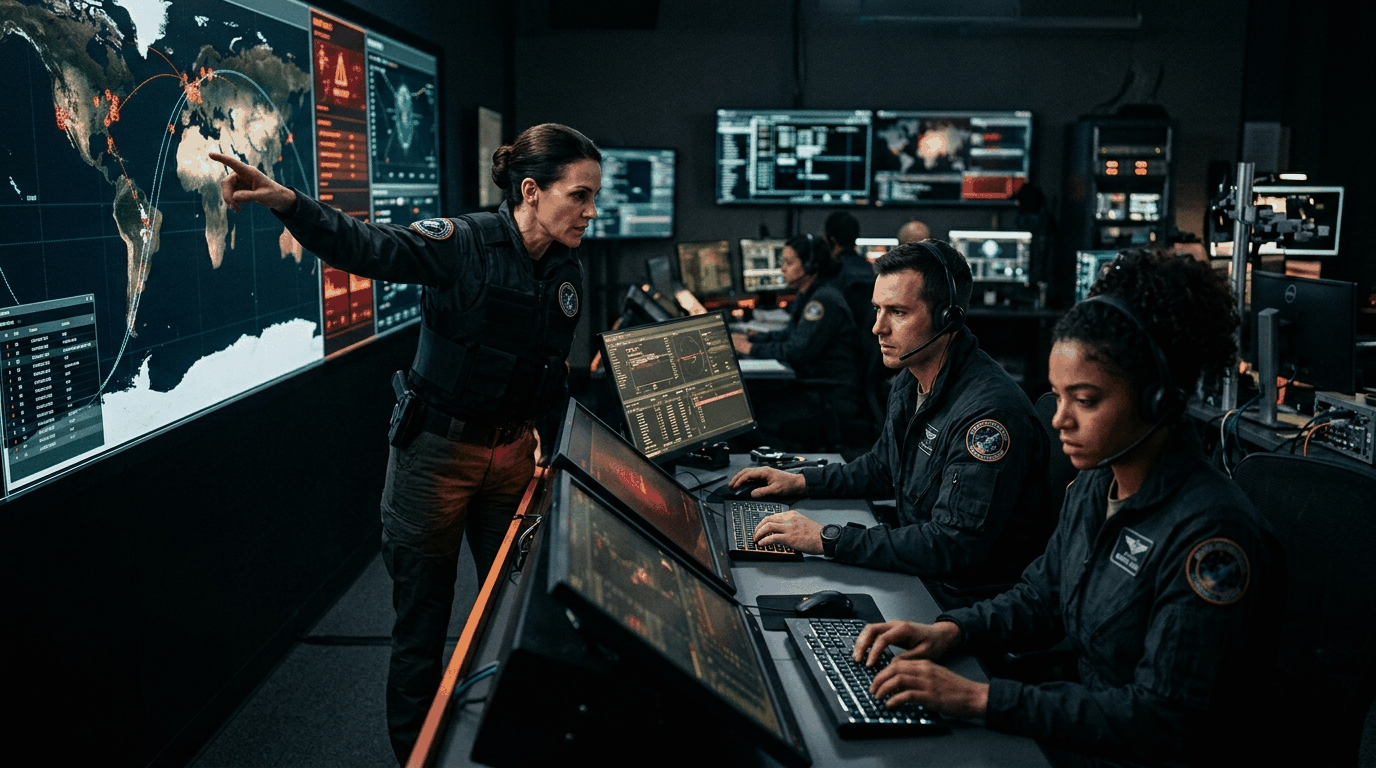
This is the capstone exercise. Students face three concurrent domain threats and must execute the full incident response lifecycle: detection, triage, containment, eradication, recovery, and documentation. Unlike previous exercises, there is no baseline phase, the scenario begins with active threat indicators requiring immediate triage and prioritization.
A suspected ASAT test generates a debris field requiring conjunction assessment. Simultaneously, a ground station intrusion alert is triggered. Students must prioritize triage: conjunction avoidance maneuver first (time-critical orbital safety), then isolate the compromised ground terminal and switch command authority to the backup station.
EW jamming activates on the primary command uplink during the response window. Students switch to the backup frequency, confirm mission continuity across all three satellites, and begin documenting the incident using the course taxonomy while the response is still active. Documentation is structured as a guided template.
This is the most complex exercise in the course. Instructors should:
The following questions will help finalize this capstone exercise design. We welcome any additional recommendations.
| Phase | Focus | Domains |
|---|---|---|
| Phase 1 | Multi-domain detection, triage, and prioritization | Kinetic + Cyber |
| Phase 2 | Response execution, mission continuity, and documentation | Kinetic + Cyber + EW |
SCORP² Practitioner | eHs® | TLP-GREEN